

Long before GPS and moving maps, pilots navigated by what they could see on the ground. In the 1930s, The Ninety-Nines launched the Airmarking Program—a hands-on effort to make flying safer by creating clear visual guides for pilots.
In aviation’s early days, cross-country flying could be tough and uncertain. With limited navigation tools, pilots followed landmarks, rail lines, and ground markings to stay on course. To help, Ninety-Nines chapters worked with local communities to paint town names, airport identifiers, and directional markings on rooftops and open spaces — giving pilots something reliable to find from the air.
A key leader in this work was Phoebe Omlie, an accomplished pilot and government official who helped develop a national approach to airmarking in partnership with the Civil Aeronautics Administration (CAA). With support from chapters across the country, The Ninety-Nines painted thousands of airmarks—often in challenging conditions—building a lasting legacy of service to aviation.
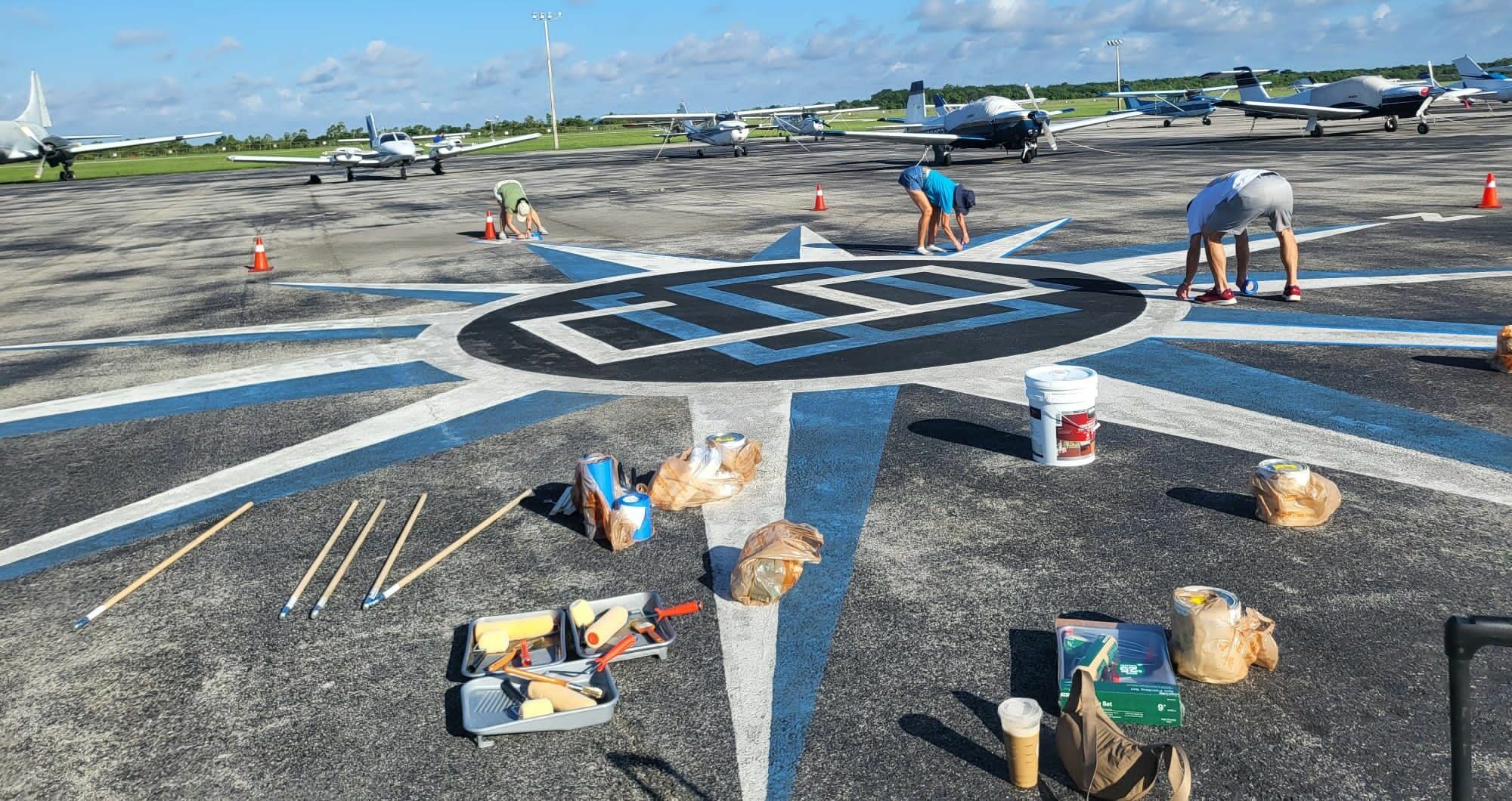
Today, the most visible part of that legacy is the Compass Rose Airmarking Program. Found at airports across the country, these striking compass roses help pilots calibrate their aircraft compasses and serve as a proud tribute to aviation history and women in flight.
Because a compass rose is large and precise, it takes teamwork. Most projects require two teams, one to lay out the pattern and one to paint.
If you would like further information on airmarking, please contact our Airmarking Chairman.
Airmarking is a proud Ninety-Nines tradition. Local chapters partner with airports and volunteers to paint compass roses—large, precise markings found at airports around the world.
Compass roses are both practical and symbolic: they help pilots check compass accuracy and serve as a visible tribute to women in aviation.
Want to host a compass rose painting? Contact The Ninety-Nines Airmarking Committee and your local airport to get started.
© 2023 Ninety Nines. All rights reserved. | Site Map
 Cathleen (Cathy) Steele
I have been an active CFI since 1998 and have accrued over 6000 of dual given. Previously I have been the Chief Flight Instructor at a Part 141 flight training school located at KBWI and also served as the Chief Flight Instructor at the first flight training academy in Nepal. Currently I am an independent Cirrus Instructor pilot with Platinum status.
Instructor Ratings: CFI, CFII
Location: Baltimore, MD, United States 
 Contact Instructor
To: Cathleen Steele
Location: Baltimore, MD, United States